
Click on a topic below for quick and easy access to important resources:

In most cases, the court determines whether a person is entitled to appointed counsel at state expense. This authority is set out in NC G.S. 7A-451(a). In some situations, North Carolina law allows other officials—such as clerks of superior court or public defenders—to make a preliminary determination of indigency and entitlement.
- North Carolina General Statute 7A-451 sets forth the right to appointed counsel at state expense.
- These are some examples when IDS cannot pay:
- Witnesses – There is no statutory basis for appointing counsel at state expense for a witness:
- The Judges’ Bench Book on Fifth Amendment privileges is explicit on this point: “[T]here is no statutory authorization for a judge to appoint counsel for a witness who is indigent, and thus the Office of Indigent Defense Services is not authorized to pay for such representation.”
- Non-Parents in A/N/D Cases (very rare exceptions)
- Most Class 3 Misdemeanors
- Witnesses – There is no statutory basis for appointing counsel at state expense for a witness:
- IDS also does not pay for most GALs.
All appointments must comply with IDS Rules and Policies.
–See IDS Rule 1.4
For additional discussion on determining indigency/appointment of counsel, see also Chapter 12.5 Part D of the NC Defender Manual: https://www.ncids.org/wp-content/uploads/2026/06/12.5_0.pdf
Please visit the following IDS webpage for details about determining indigency: https://www.ncids.org/indigency-defined/
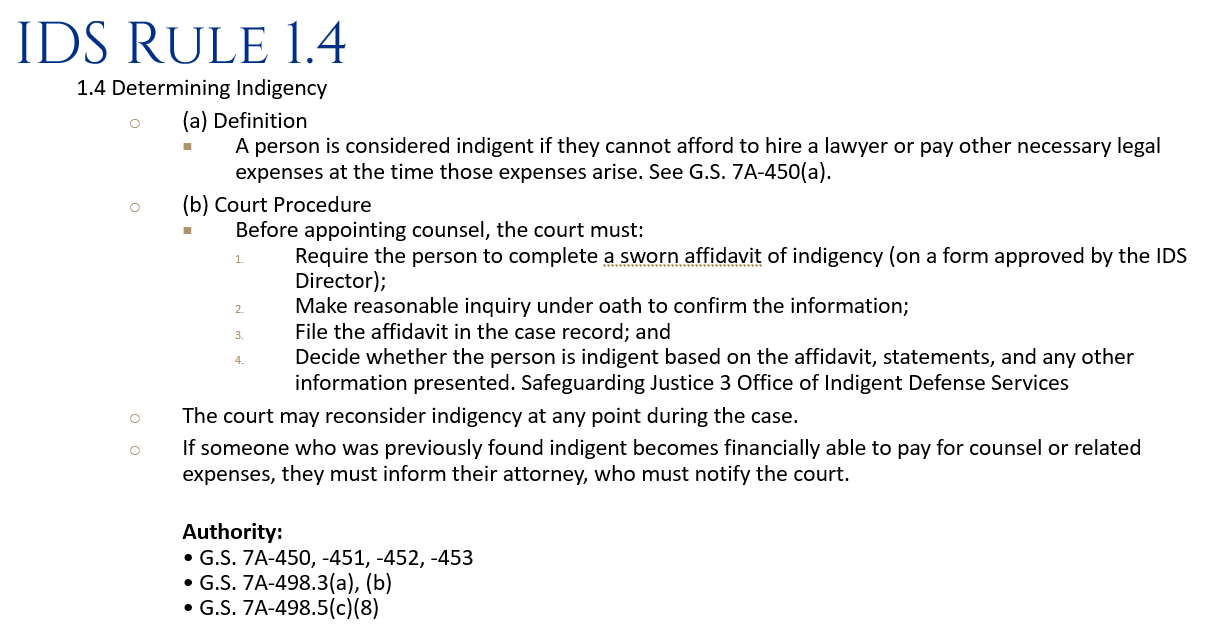
See Rule 1.4 below for IDS requirements:
Appointment Plans: You can access local appointment plans by using the interactive NC county map posted here: https://www.ncids.org/map/. Select a county, and when the information window appears, click on the “More Info” hyperlink.
Our OASIS FAQ includes the following guidance for judges: https://www.ncids.org/oasis-guidance-for-judges/
In the rare event a fee app amount is reduced outside of court, please contact Aaron Gallagher, at [email protected].
Under G.S. 7A-455, a trial court must direct that a civil judgment for the money value of services rendered be appointed counsel be entered against defendants who are convicted, whether at trial or by guilty plea. The value of services must be determined in accordance with IDS Rules and certain factors described by the statute. G.S. 7A-455(b). In addition to the value of services rendered, G.S. 7A455.1 requires convicted defendants to pay an appointment fee of seventy-five dollars. Before imposing attorney’s fees, the trial court must give the defendant notice of the total amount of fees to be imposed and ask the defendant personally whether he or she wishes to be heard on the issue.
Friend Hearings:
While N.C. Gen. Stat. § 7A-455 requires judges to enter civil judgments in cases that end in conviction, before entering judgment the defendant must have notice and an opportunity to be heard. In assessing the amount of the judgment, trial courts awarding counsel fees must take into account factors such as “the nature of the case, the time, effort, and responsibility involved, and the fee usually charged in similar cases.” N.C. Gen. Stat. § 7A-455(b). See State v. Friend, 257 N.C. App. 516, 523 (2018).
Click the following link to access useful guidance from the Office of the Parent Defender: https://www.ncids.org/wp-content/uploads/2026/06/2026-Appointment-of-Counsel-for-Non-Parent-Respondents.pdf
Note: The Form AOC-J-211 will go live on July 1, 2026.
- NC District Court Judges’ Benchbook (Purchase Page)
Important Sections:
Judge’s Warning of Right to Invoke Privilege
Statutory Right to Appointed Counsel
For additional discussion on determining indigency, see also Chapter 12.5 Part D of the NC Defender Manual: https://www.ncids.org/wp-content/uploads/2026/06/12.5_0.pdf
Reminder: IDS offers a wealth of free resources, tools and training to attorneys.
Every day, IDS helps attorneys to become qualified and ready to handle the most serious and complex cases. As an adjudicator, you can help by pointing them in the right direction.
Bookmark this link to our attorney resources webpage. Share it with lawyers you know who take on court appointed work: https://www.ncids.org/ids-trial-resources/
When attorneys can do a great job in the courtroom, you don’t have to worry about the quality of representation–you can focus on administering justice and applying the law.